
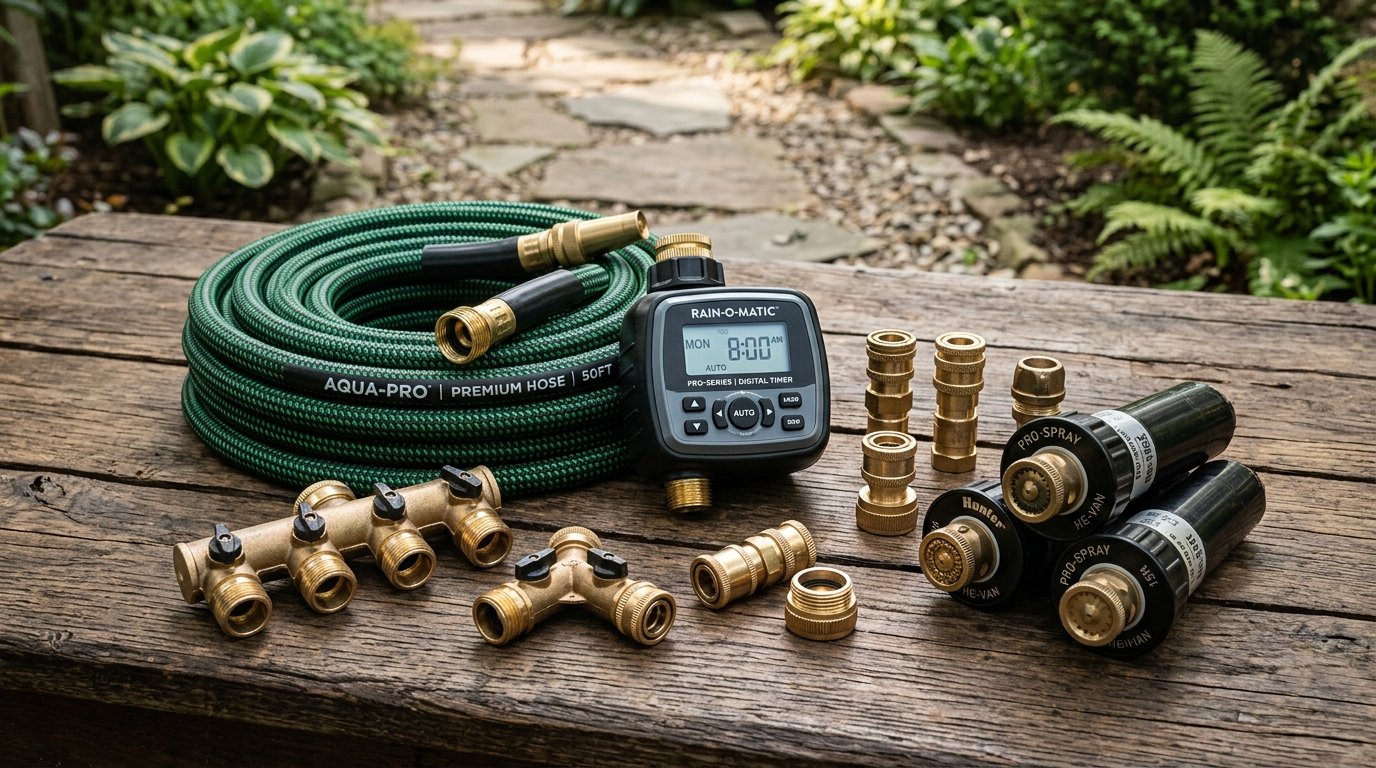
Automatic Nozzles
Automatic nozzles are the ideal solution for anyone looking to automate garden watering without daily manual intervention. Whether for a vegetable patch, a lawn, or ornamental flower beds, these devices ensure a regular and even distribution of water. Their ability to run autonomously once installed on your irrigation network saves you valuable time while guaranteeing optimal watering.
The main types of automatic nozzles for your garden
360-degree rotary nozzles
Rotary nozzles cover a full circular area thanks to their rotating head. They are particularly suited to large lawns and open spaces free of obstacles. Their range generally varies between 3 and 8 metres depending on available pressure. Continuous rotation ensures even water distribution across the whole area.
Oscillating and sector nozzles
Oscillating models sweep a rectangular or arc-shaped zone, with adjustable angles of 90°, 180°, or 270°. They adapt better to rectangular gardens or border areas. Their back-and-forth motion prevents water waste on paths or unplanted surfaces. Most models allow you to adjust the width and range of the spray.
Automatic drip systems
Drip nozzles deliver water directly to the base of plants, with a controlled flow rate generally between 2 and 8 litres per hour. This technique minimises evaporation and precisely targets the roots. Kits can include 30, 60, or 120 nozzles depending on the area to cover. They install easily on a porous hose or a micro-irrigation circuit.
Key criteria for choosing your automatic nozzles
Area to water and required range
The size of your garden determines the number and type of nozzles to install. For a lawn of 20 to 50 m², opt for 2 to 4 rotary nozzles with a medium range (4-6 metres). Beyond 100 m², a system with 6 to 10 extended-range nozzles becomes necessary. Drip systems suit vegetable patches and flower beds under 30 m².
Available water pressure and flow rate
Your network’s pressure determines how the nozzles perform. Most require a minimum pressure of 2 bar to work properly, while high-end models can operate from as low as 1.5 bar. Required flow rate ranges from 300 litres per hour for a simple sprinkler to over 1000 litres per hour for a multi-nozzle system. Check that your installation can supply the combined flow rate of all nozzles running simultaneously.
Materials and UV resistance
ABS plastic nozzles withstand impacts and UV exposure, with a lifespan of 3 to 5 years under intensive use. Models with brass or stainless-steel components offer greater longevity, particularly for rotating mechanisms. Favour nozzles with EPDM rubber seals, which maintain their watertightness despite temperature variations. Reinforced polypropylene bodies better withstand residual frost and frequent handling.
Installation and compatibility of your automatic nozzles
Standard connections and diameters
Most automatic nozzles connect to hoses with a diameter of 13, 16, or 19 mm. Quick-connect fittings allow tool-free installation in seconds. For underground systems, plan for threaded connectors of 20×27 mm (3/4 inch) or 26×34 mm (1 inch). Drip kits generally use 4/6 mm tubing for individual branch lines.
Integration with an existing system
Check compatibility with your irrigation controller if you already have one. Automatic nozzles run on 24V solenoid valves or battery-powered programmable taps. A pressure reducer may be necessary if your network exceeds 4 bar. When adding nozzles to an existing setup, calculate the total flow rate to avoid an excessive pressure drop.
Possible settings and adjustments
Adjustable nozzles let you change the watering angle, spray range, and sometimes the flow rate. A simple screwdriver is usually enough to adjust these settings. Test your installation during the day before letting it run automatically. Reposition any nozzles that create dry patches or excessive overlap.
Maintenance and durability of automatic nozzles
Regular cleaning of filters and nozzles
Monthly filter cleaning prevents clogging from suspended particles. Unscrew the nozzle heads and rinse them with clean water to remove limescale deposits. For drip systems, check each dripper every two months during the season. A soft brush and white vinegar are enough to dissolve stubborn build-up.
Winter protection and storage
Before the first frosts, fully drain the circuit by opening all nozzles and purging compressed air if available. Remove any movable nozzles and store them somewhere dry and frost-free. Underground nozzles must be drained via the dedicated drain valves. Neglecting winterisation can lead to irreversible cracks caused by the expansion of frozen water.
Adapting automatic nozzles to your specific needs
Watering lawns and grass
For a dense lawn, choose nozzles with fine droplets that soak in without running off. Watering early in the morning or in the evening limits evaporation. Schedule short but frequent cycles rather than a single prolonged watering session. An installation height of 15 to 30 cm above ground level improves distribution.
Irrigating vegetable patches and flower beds
Drip systems are essential for row crops such as tomatoes, lettuce, or beans. Place one nozzle every 20 to 30 cm along the rows. For flower beds, adjustable-flow micro-sprinklers avoid wetting the foliage, thereby reducing the risk of fungal disease. Adjust the flow rate according to each plant’s specific needs.
Fully automating the system
Pair your nozzles with a controller that triggers watering during set time slots. Models with a rain sensor pause irrigation during rainfall. For optimal management, divide your garden into zones and schedule different durations based on each zone’s needs. A well-configured system can cut water consumption by 30 to 40% compared with manual watering.
- Define the total area to be watered and calculate the number of nozzles needed based on their range
- Check the pressure and flow rate available at your tap before buying
- Choose UV- and frost-resistant materials if the nozzles stay in place year-round
- Favour models with angle and range adjustments to adapt as your garden evolves
- For vegetable patches, opt for drip irrigation, which saves water and targets the roots
- Make sure it’s compatible with your existing system (hose diameter, fittings)
- Choose nozzles with built-in filters if your water contains a lot of particles
- Calculate the overall installation cost, including hoses, fittings, and any controller
| Nozzle type | Range | Flow rate | Angle | Recommended use |
|---|---|---|---|---|
| 360° rotary | 3 to 8 m | 300-800 L/h | Full circle | Central lawn, large areas |
| Adjustable oscillating | 4 to 12 m | 400-1000 L/h | 90° to 270° | Rectangular gardens, borders |
| Drip | 0.3 to 1 m | 2-8 L/h per nozzle | Localised vertical | Vegetable patch, flower beds, pots |
| Micro-sprinkler | 1 to 3 m | 20-60 L/h | 180° or 360° | Small flower beds, low hedges |
How do I choose between rotary and oscillating nozzles for my lawn?
Rotary nozzles suit circular or square lawns free of obstacles, providing even coverage across a full 360°. Oscillating models adapt better to rectangular gardens or border areas where you want to avoid watering paths or the house front. If your lawn is under 30 m², an oscillating nozzle is usually enough. Beyond that, combine several rotary nozzles for full coverage with no dry patches.
What minimum pressure is needed to run automatic nozzles?
Most automatic nozzles need a pressure of 2 to 3 bar for optimal performance. Some low-pressure models work from as little as 1.5 bar, useful if your network has low pressure or if you’re installing many nozzles at once. Test the pressure with a gauge at your tap before buying. If it’s insufficient, a booster pump may be needed, or consider a drip system, which works from as little as 0.5 bar.
Can automatic nozzles be used with a rainwater harvester?
Yes, provided you install a suitable pump that delivers the required pressure and flow rate. Gravity-fed harvesters typically offer less than 0.5 bar, which is insufficient for standard nozzles. A 600 to 1000 watt surface pump can supply 3 to 6 rotary nozzles depending on their flow rate. Also plan for an upstream filter to trap particles and protect the mechanisms. Drip systems only need a 200-watt pump for an average-sized area.
How many nozzles are needed to cover a 50 m² garden?
For 50 m², plan on 2 to 4 rotary nozzles with a range of 4 to 5 metres each, depending on the shape of the plot. A rectangular garden may only need 2 well-positioned oscillating nozzles. For a vegetable patch, a drip kit with 30 to 60 individual nozzles spread along the rows will be more suitable. Sketch your garden on paper, draw the range circles for each nozzle, and adjust their number to avoid uncovered areas.
You might also like
Automatic nozzles are the ideal solution for anyone looking to automate garden watering without daily manual intervention. Whether for a vegetable patch, a lawn, or ornamental flower beds, these devices ensure a regular and even distribution of water. Their ability to run autonomously once installed on your irrigation network saves you valuable time while guaranteeing optimal watering.
The main types of automatic nozzles for your garden
360-degree rotary nozzles
Rotary nozzles cover a full circular area thanks to their rotating head. They are particularly suited to large lawns and open spaces free of obstacles. Their range generally varies between 3 and 8 metres depending on available pressure. Continuous rotation ensures even water distribution across the whole area.
Oscillating and sector nozzles
Oscillating models sweep a rectangular or arc-shaped zone, with adjustable angles of 90°, 180°, or 270°. They adapt better to rectangular gardens or border areas. Their back-and-forth motion prevents water waste on paths or unplanted surfaces. Most models allow you to adjust the width and range of the spray.
Automatic drip systems
Drip nozzles deliver water directly to the base of plants, with a controlled flow rate generally between 2 and 8 litres per hour. This technique minimises evaporation and precisely targets the roots. Kits can include 30, 60, or 120 nozzles depending on the area to cover. They install easily on a porous hose or a micro-irrigation circuit.
Key criteria for choosing your automatic nozzles
Area to water and required range
The size of your garden determines the number and type of nozzles to install. For a lawn of 20 to 50 m², opt for 2 to 4 rotary nozzles with a medium range (4-6 metres). Beyond 100 m², a system with 6 to 10 extended-range nozzles becomes necessary. Drip systems suit vegetable patches and flower beds under 30 m².
Available water pressure and flow rate
Your network's pressure determines how the nozzles perform. Most require a minimum pressure of 2 bar to work properly, while high-end models can operate from as low as 1.5 bar. Required flow rate ranges from 300 litres per hour for a simple sprinkler to over 1000 litres per hour for a multi-nozzle system. Check that your installation can supply the combined flow rate of all nozzles running simultaneously.
Materials and UV resistance
ABS plastic nozzles withstand impacts and UV exposure, with a lifespan of 3 to 5 years under intensive use. Models with brass or stainless-steel components offer greater longevity, particularly for rotating mechanisms. Favour nozzles with EPDM rubber seals, which maintain their watertightness despite temperature variations. Reinforced polypropylene bodies better withstand residual frost and frequent handling.
Installation and compatibility of your automatic nozzles
Standard connections and diameters
Most automatic nozzles connect to hoses with a diameter of 13, 16, or 19 mm. Quick-connect fittings allow tool-free installation in seconds. For underground systems, plan for threaded connectors of 20x27 mm (3/4 inch) or 26x34 mm (1 inch). Drip kits generally use 4/6 mm tubing for individual branch lines.
Integration with an existing system
Check compatibility with your irrigation controller if you already have one. Automatic nozzles run on 24V solenoid valves or battery-powered programmable taps. A pressure reducer may be necessary if your network exceeds 4 bar. When adding nozzles to an existing setup, calculate the total flow rate to avoid an excessive pressure drop.
Possible settings and adjustments
Adjustable nozzles let you change the watering angle, spray range, and sometimes the flow rate. A simple screwdriver is usually enough to adjust these settings. Test your installation during the day before letting it run automatically. Reposition any nozzles that create dry patches or excessive overlap.
Maintenance and durability of automatic nozzles
Regular cleaning of filters and nozzles
Monthly filter cleaning prevents clogging from suspended particles. Unscrew the nozzle heads and rinse them with clean water to remove limescale deposits. For drip systems, check each dripper every two months during the season. A soft brush and white vinegar are enough to dissolve stubborn build-up.
Winter protection and storage
Before the first frosts, fully drain the circuit by opening all nozzles and purging compressed air if available. Remove any movable nozzles and store them somewhere dry and frost-free. Underground nozzles must be drained via the dedicated drain valves. Neglecting winterisation can lead to irreversible cracks caused by the expansion of frozen water.
Adapting automatic nozzles to your specific needs
Watering lawns and grass
For a dense lawn, choose nozzles with fine droplets that soak in without running off. Watering early in the morning or in the evening limits evaporation. Schedule short but frequent cycles rather than a single prolonged watering session. An installation height of 15 to 30 cm above ground level improves distribution.
Irrigating vegetable patches and flower beds
Drip systems are essential for row crops such as tomatoes, lettuce, or beans. Place one nozzle every 20 to 30 cm along the rows. For flower beds, adjustable-flow micro-sprinklers avoid wetting the foliage, thereby reducing the risk of fungal disease. Adjust the flow rate according to each plant's specific needs.
Fully automating the system
Pair your nozzles with a controller that triggers watering during set time slots. Models with a rain sensor pause irrigation during rainfall. For optimal management, divide your garden into zones and schedule different durations based on each zone's needs. A well-configured system can cut water consumption by 30 to 40% compared with manual watering.
- Define the total area to be watered and calculate the number of nozzles needed based on their range
- Check the pressure and flow rate available at your tap before buying
- Choose UV- and frost-resistant materials if the nozzles stay in place year-round
- Favour models with angle and range adjustments to adapt as your garden evolves
- For vegetable patches, opt for drip irrigation, which saves water and targets the roots
- Make sure it's compatible with your existing system (hose diameter, fittings)
- Choose nozzles with built-in filters if your water contains a lot of particles
- Calculate the overall installation cost, including hoses, fittings, and any controller
| Nozzle type | Range | Flow rate | Angle | Recommended use |
|---|---|---|---|---|
| 360° rotary | 3 to 8 m | 300-800 L/h | Full circle | Central lawn, large areas |
| Adjustable oscillating | 4 to 12 m | 400-1000 L/h | 90° to 270° | Rectangular gardens, borders |
| Drip | 0.3 to 1 m | 2-8 L/h per nozzle | Localised vertical | Vegetable patch, flower beds, pots |
| Micro-sprinkler | 1 to 3 m | 20-60 L/h | 180° or 360° | Small flower beds, low hedges |
How do I choose between rotary and oscillating nozzles for my lawn?
Rotary nozzles suit circular or square lawns free of obstacles, providing even coverage across a full 360°. Oscillating models adapt better to rectangular gardens or border areas where you want to avoid watering paths or the house front. If your lawn is under 30 m², an oscillating nozzle is usually enough. Beyond that, combine several rotary nozzles for full coverage with no dry patches.
What minimum pressure is needed to run automatic nozzles?
Most automatic nozzles need a pressure of 2 to 3 bar for optimal performance. Some low-pressure models work from as little as 1.5 bar, useful if your network has low pressure or if you're installing many nozzles at once. Test the pressure with a gauge at your tap before buying. If it's insufficient, a booster pump may be needed, or consider a drip system, which works from as little as 0.5 bar.
Can automatic nozzles be used with a rainwater harvester?
Yes, provided you install a suitable pump that delivers the required pressure and flow rate. Gravity-fed harvesters typically offer less than 0.5 bar, which is insufficient for standard nozzles. A 600 to 1000 watt surface pump can supply 3 to 6 rotary nozzles depending on their flow rate. Also plan for an upstream filter to trap particles and protect the mechanisms. Drip systems only need a 200-watt pump for an average-sized area.
How many nozzles are needed to cover a 50 m² garden?
For 50 m², plan on 2 to 4 rotary nozzles with a range of 4 to 5 metres each, depending on the shape of the plot. A rectangular garden may only need 2 well-positioned oscillating nozzles. For a vegetable patch, a drip kit with 30 to 60 individual nozzles spread along the rows will be more suitable. Sketch your garden on paper, draw the range circles for each nozzle, and adjust their number to avoid uncovered areas.
Automatic nozzles are the ideal solution for anyone looking to automate garden watering without daily manual intervention. Whether for a vegetable patch, a lawn, or ornamental flower beds, these devices ensure a regular and even distribution of water. Their ability to run autonomously once installed on your irrigation network saves you valuable time while guaranteeing optimal watering.
The main types of automatic nozzles for your garden
360-degree rotary nozzles
Rotary nozzles cover a full circular area thanks to their rotating head. They are particularly suited to large lawns and open spaces free of obstacles. Their range generally varies between 3 and 8 metres depending on available pressure. Continuous rotation ensures even water distribution across the whole area.
Oscillating and sector nozzles
Oscillating models sweep a rectangular or arc-shaped zone, with adjustable angles of 90°, 180°, or 270°. They adapt better to rectangular gardens or border areas. Their back-and-forth motion prevents water waste on paths or unplanted surfaces. Most models allow you to adjust the width and range of the spray.
Automatic drip systems
Drip nozzles deliver water directly to the base of plants, with a controlled flow rate generally between 2 and 8 litres per hour. This technique minimises evaporation and precisely targets the roots. Kits can include 30, 60, or 120 nozzles depending on the area to cover. They install easily on a porous hose or a micro-irrigation circuit.
Key criteria for choosing your automatic nozzles
Area to water and required range
The size of your garden determines the number and type of nozzles to install. For a lawn of 20 to 50 m², opt for 2 to 4 rotary nozzles with a medium range (4-6 metres). Beyond 100 m², a system with 6 to 10 extended-range nozzles becomes necessary. Drip systems suit vegetable patches and flower beds under 30 m².
Available water pressure and flow rate
Your network’s pressure determines how the nozzles perform. Most require a minimum pressure of 2 bar to work properly, while high-end models can operate from as low as 1.5 bar. Required flow rate ranges from 300 litres per hour for a simple sprinkler to over 1000 litres per hour for a multi-nozzle system. Check that your installation can supply the combined flow rate of all nozzles running simultaneously.
Materials and UV resistance
ABS plastic nozzles withstand impacts and UV exposure, with a lifespan of 3 to 5 years under intensive use. Models with brass or stainless-steel components offer greater longevity, particularly for rotating mechanisms. Favour nozzles with EPDM rubber seals, which maintain their watertightness despite temperature variations. Reinforced polypropylene bodies better withstand residual frost and frequent handling.
Installation and compatibility of your automatic nozzles
Standard connections and diameters
Most automatic nozzles connect to hoses with a diameter of 13, 16, or 19 mm. Quick-connect fittings allow tool-free installation in seconds. For underground systems, plan for threaded connectors of 20×27 mm (3/4 inch) or 26×34 mm (1 inch). Drip kits generally use 4/6 mm tubing for individual branch lines.
Integration with an existing system
Check compatibility with your irrigation controller if you already have one. Automatic nozzles run on 24V solenoid valves or battery-powered programmable taps. A pressure reducer may be necessary if your network exceeds 4 bar. When adding nozzles to an existing setup, calculate the total flow rate to avoid an excessive pressure drop.
Possible settings and adjustments
Adjustable nozzles let you change the watering angle, spray range, and sometimes the flow rate. A simple screwdriver is usually enough to adjust these settings. Test your installation during the day before letting it run automatically. Reposition any nozzles that create dry patches or excessive overlap.
Maintenance and durability of automatic nozzles
Regular cleaning of filters and nozzles
Monthly filter cleaning prevents clogging from suspended particles. Unscrew the nozzle heads and rinse them with clean water to remove limescale deposits. For drip systems, check each dripper every two months during the season. A soft brush and white vinegar are enough to dissolve stubborn build-up.
Winter protection and storage
Before the first frosts, fully drain the circuit by opening all nozzles and purging compressed air if available. Remove any movable nozzles and store them somewhere dry and frost-free. Underground nozzles must be drained via the dedicated drain valves. Neglecting winterisation can lead to irreversible cracks caused by the expansion of frozen water.
Adapting automatic nozzles to your specific needs
Watering lawns and grass
For a dense lawn, choose nozzles with fine droplets that soak in without running off. Watering early in the morning or in the evening limits evaporation. Schedule short but frequent cycles rather than a single prolonged watering session. An installation height of 15 to 30 cm above ground level improves distribution.
Irrigating vegetable patches and flower beds
Drip systems are essential for row crops such as tomatoes, lettuce, or beans. Place one nozzle every 20 to 30 cm along the rows. For flower beds, adjustable-flow micro-sprinklers avoid wetting the foliage, thereby reducing the risk of fungal disease. Adjust the flow rate according to each plant’s specific needs.
Fully automating the system
Pair your nozzles with a controller that triggers watering during set time slots. Models with a rain sensor pause irrigation during rainfall. For optimal management, divide your garden into zones and schedule different durations based on each zone’s needs. A well-configured system can cut water consumption by 30 to 40% compared with manual watering.
- Define the total area to be watered and calculate the number of nozzles needed based on their range
- Check the pressure and flow rate available at your tap before buying
- Choose UV- and frost-resistant materials if the nozzles stay in place year-round
- Favour models with angle and range adjustments to adapt as your garden evolves
- For vegetable patches, opt for drip irrigation, which saves water and targets the roots
- Make sure it’s compatible with your existing system (hose diameter, fittings)
- Choose nozzles with built-in filters if your water contains a lot of particles
- Calculate the overall installation cost, including hoses, fittings, and any controller
| Nozzle type | Range | Flow rate | Angle | Recommended use |
|---|---|---|---|---|
| 360° rotary | 3 to 8 m | 300-800 L/h | Full circle | Central lawn, large areas |
| Adjustable oscillating | 4 to 12 m | 400-1000 L/h | 90° to 270° | Rectangular gardens, borders |
| Drip | 0.3 to 1 m | 2-8 L/h per nozzle | Localised vertical | Vegetable patch, flower beds, pots |
| Micro-sprinkler | 1 to 3 m | 20-60 L/h | 180° or 360° | Small flower beds, low hedges |
How do I choose between rotary and oscillating nozzles for my lawn?
Rotary nozzles suit circular or square lawns free of obstacles, providing even coverage across a full 360°. Oscillating models adapt better to rectangular gardens or border areas where you want to avoid watering paths or the house front. If your lawn is under 30 m², an oscillating nozzle is usually enough. Beyond that, combine several rotary nozzles for full coverage with no dry patches.
What minimum pressure is needed to run automatic nozzles?
Most automatic nozzles need a pressure of 2 to 3 bar for optimal performance. Some low-pressure models work from as little as 1.5 bar, useful if your network has low pressure or if you’re installing many nozzles at once. Test the pressure with a gauge at your tap before buying. If it’s insufficient, a booster pump may be needed, or consider a drip system, which works from as little as 0.5 bar.
Can automatic nozzles be used with a rainwater harvester?
Yes, provided you install a suitable pump that delivers the required pressure and flow rate. Gravity-fed harvesters typically offer less than 0.5 bar, which is insufficient for standard nozzles. A 600 to 1000 watt surface pump can supply 3 to 6 rotary nozzles depending on their flow rate. Also plan for an upstream filter to trap particles and protect the mechanisms. Drip systems only need a 200-watt pump for an average-sized area.
How many nozzles are needed to cover a 50 m² garden?
For 50 m², plan on 2 to 4 rotary nozzles with a range of 4 to 5 metres each, depending on the shape of the plot. A rectangular garden may only need 2 well-positioned oscillating nozzles. For a vegetable patch, a drip kit with 30 to 60 individual nozzles spread along the rows will be more suitable. Sketch your garden on paper, draw the range circles for each nozzle, and adjust their number to avoid uncovered areas.