
Automatic Irrigation Kits
Showing all 31 results
-

2-16 Head Automatic Watering Kits
-

3W Solar Irrigation System
-

5-30m Atomizing Micro-Sprinkler Kit
-

5-50M Automatic Garden Watering System
-

Automatic Drip Irrigation Kit, 10 Pieces
-

Automatic Drip Irrigation System 5-60M
-

Automatic Drip Irrigation System for Plants
-

Automatic Drip Watering System for Indoor Plants
-

Automatic Plant Watering System with Timer
-

Automatic spray irrigation system
-

Automatic Tree Watering Kit with Drip Irrigation Dart
-

Automatic Watering Device
-

DIY Automatic Irrigation Module Kit
-

DIY automatic micro drip irrigation system
-

DIY portable drip irrigation system 2-200M
-

Drip irrigation kit
-

Drip Irrigation Kit for Potted Plants
-

Drip Irrigation System
-

Drip Irrigation System Kit
-

Garden drip irrigation regulation kit
-

Greenhouse Drip Irrigation System
-

Micro drip irrigation system
-

Micro-Misting Irrigation Kit
-

New Solar Automatic Watering Irrigation Equipment Kit, WiFi Mobile App Remote Timed Control Tool
-

OASIS 50M-5M DIY drip irrigation system
-

Portable drip irrigation system 2-200M
-

Portable drip irrigation system 5-20M
-

Portable micro drip irrigation system 20M
-

Smart WiFi Garden Irrigation Controller
-

Solar WiFi Automatic Watering Machine Kit
-

Solar-Powered Automatic Drip Irrigation Kit
The different types of automatic irrigation kits
An automatic irrigation kit brings together everything you need to water your plants without daily manual intervention. Drip irrigation systems are the most common solution for gardens, vegetable patches and flower beds, since they deliver water directly to the base of each plant at a controlled flow rate. Kits for indoor plants generally work on the same principle but with lower flow rates and self-contained reservoirs. Dual-pump systems let you irrigate two separate zones with different schedules.
Outdoor drip irrigation kits
These sets include a main hose 4 to 6 mm in diameter, adjustable drippers, support stakes and connectors. Length ranges from 5 to 50 metres depending on the area to cover. Flow per dripper ranges from 2 to 8 litres per hour, letting you tailor watering to each plant’s specific needs. Recommended operating pressure is between 1 and 3 bar.
Watering systems for indoor plants
These self-contained kits include a 5- to 20-litre water reservoir and fine capillary tubing. They work by gravity or with a micro-pump powered by batteries or USB. Flow is reduced to a few drops per minute to prevent overwatering. Ideal for extended absences, they maintain steady moisture levels without any supervision.
Kits with timers and smart control
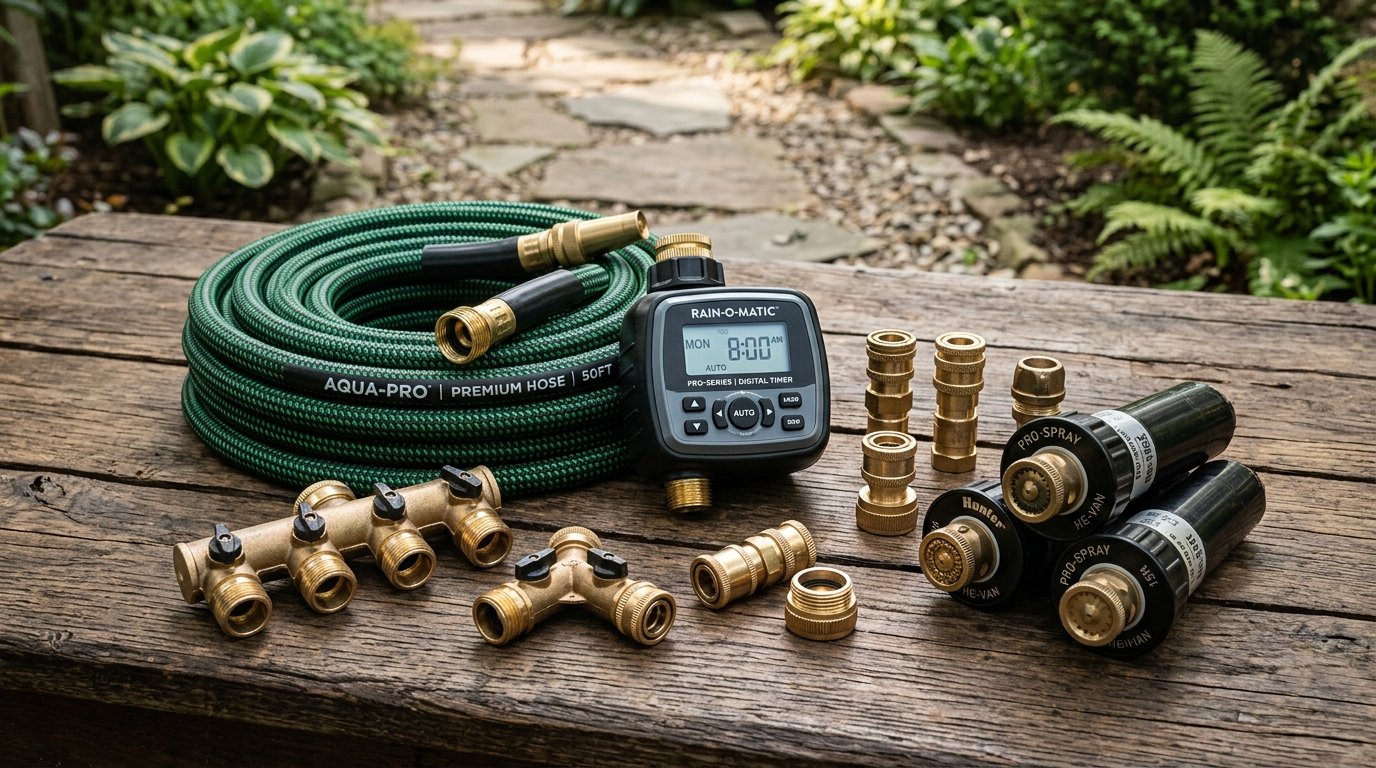
Advanced versions come with an electronic timer or a wifi controller. Connected models let you manage watering from a mobile app, adjust cycles based on the weather and receive alerts. Some include soil moisture sensors that trigger watering only when needed. Battery-powered mechanical timers remain a reliable, budget-friendly option for simple weekly settings.
Selection criteria based on area and number of plants
The first step is to accurately assess your irrigation needs. A 20 m² garden with around twenty plants needs a kit of about ten metres with 20 to 30 drippers. For a 100 m² area, go for expandable kits of 30 to 50 metres. The number of drippers should match the number of watering points, sometimes allowing two drippers per water-hungry plant.
Calculating your flow rate and pressure needs
The kit’s total flow rate depends on the number of drippers and their individual output. For 30 drippers at 4 litres/hour, total flow reaches 120 litres/hour. Check that your water source can supply this flow without a pressure drop. Minimum required pressure is generally 1 bar, but some systems with a built-in pump work from 0.5 bar, useful for rainwater tanks.
Hose length and number of drippers
Standard kits include between 10 and 50 metres of main hose. Plan the layout by measuring the distance from the tap to the areas to be irrigated. Allow 10 to 20% extra length for detours and connections. Drippers can be added or removed freely along the hose to adapt the system as your plantings evolve.
Water supply: tap, tank or reservoir
Most kits connect directly to an outdoor tap, with a pressure reducer if needed. For watering from a rainwater tank, choose a kit with a submersible or suction pump that works from 0.5 bar. Self-contained indoor systems have their own reservoir to be filled manually.
Automation and watering control
Automation is at the heart of an effective irrigation kit. It prevents missed waterings, keeps a watering routine that benefits plants, and lets you manage irrigation while you’re away. The choice of control system depends on the level of automation you want and your budget.
Mechanical and electronic timers
Battery-powered mechanical timers work with a dial to set watering duration and frequency, typically 1 to 120 minutes per cycle, up to several times a day. Electronic versions offer more flexibility with customisable weekly cycles and several independent programs. Battery life ranges from 3 to 12 months depending on the model and frequency of use.
Wifi-connected controllers and apps
Smart controllers are managed via smartphone or tablet. They automatically adjust watering based on weather forecasts and measured humidity. You can trigger a manual cycle remotely, check watering history and receive notifications in case of a malfunction. Simple installation via home wifi, compatible with voice assistants on some models.
Moisture sensors and rain gauges
Adding soil moisture sensors helps avoid unnecessary watering after rain or when the soil is still damp. The sensor probes the soil and blocks the scheduled cycle if the moisture threshold is reached. Rain gauges temporarily disable the system after rainfall. These accessories cut water use by 20 to 40% and protect plants from overwatering.
Installation and system compatibility
Ease of installation is a key criterion for beginner gardeners or those wanting a quick setup. Kits range from ready-to-install systems set up in minutes to modular systems requiring custom design.
Ready-to-install kits or modular systems
Complete kits include all components pre-assembled with an illustrated guide. You unroll the hose, position the drippers and connect to the tap in 15 to 30 minutes. Modular systems let you build your setup by choosing the hose, drippers, connectors and timer separately. This option suits gardens with complex layouts or specific needs.
Connection and adapting to your existing setup
Check your tap’s diameter: standard connectors fit 20/27 and 26/34 threads. A pressure reducer is recommended if your mains pressure exceeds 3 bar, to protect seals and prevent bursts. For tanks, choose kits with a built-in pump or add a submersible pump of 300 to 600 litres/hour depending on your needs.
Extending and upgrading the kit
Choose an expandable system if you plan to enlarge your garden. Most kits allow additional hoses to be added via T-connectors or cross connectors. You can add more drippers, upgrade to a more advanced timer, or create branches to new areas. Stick with the same brand or check hose diameter compatibility.
Materials, durability and maintenance
The lifespan of an irrigation kit depends on component quality and regular maintenance. A well-chosen, properly maintained system runs trouble-free for 5 to 10 years.
Hose and dripper quality
Choose low-density polyethylene or reinforced PVC hoses, flexible yet resistant to kinking. Wall thickness should be at least 1 mm to prevent punctures. Anti-siphon, self-cleaning drippers help prevent clogging from debris. Compression fittings ensure a lasting seal without glue or special tools.
UV and frost resistance
Hoses exposed to sunlight should be UV-treated to stay flexible and avoid cracking after a few seasons. In cold regions, choose frost-resistant materials or plan to drain the system before winter. Buried kits benefit from natural protection against UV and temperature swings.
Seasonal kit maintenance
In spring, check connector seals and clean the filters. Check that each dripper flows properly and replace any that are blocked. At the end of the season, drain the system, remove the timer for storage away from frost, and empty the pump if fitted. An annual descaling of drippers in white vinegar extends their lifespan.
Key selection criteria
- Area to be irrigated and number of plants to water, to size the hose length
- Type of plants: low-flow drip for delicate plants, higher flow for vegetable gardens
- Available water source: tap pressure, tank capacity, self-contained reservoir
- Desired level of automation: simple, electronic or wifi-connected timer
- Ease of installation: ready-to-install complete kit or modular system to build
- System expandability for adding watering zones later
- UV and frost resistance depending on climate and installation method
- Presence of moisture sensors or a rain gauge to save water
- Material quality: reinforced hose, self-cleaning drippers, watertight connectors
- Manufacturer warranty and availability of spare parts
| Kit type | Coverage area | Dripper flow rate | Automation | Typical use |
|---|---|---|---|---|
| Basic drip kit | 5-20 m² | 2-4 L/h | No timer | Small vegetable patch, balcony |
| Kit with mechanical timer | 20-50 m² | 4-6 L/h | Simple cycles | Flower beds, hedges |
| Kit with wifi controller | 50-100 m² | 4-8 L/h | Smartphone control | Large garden, frequent absences |
| Dual-pump system | 100-200 m² | 6-8 L/h | Multi-zone scheduling | Complex garden, multiple zones |
| Indoor plant kit | 10-30 pots | 0.1-0.5 L/h | Self-contained reservoir | Potted plants, absences |
How do I choose the right hose length for my garden?
Measure the distance between the tap and the farthest area to be irrigated, then add 20% for detours and connections. For a 30 m² garden, a 15 to 20 metre kit is generally enough. Expandable systems let you add extra length if needed. Sketch the hose route on a plan to optimise the number of metres required.
What’s the difference between a mechanical timer and a wifi controller?
The mechanical timer runs on a battery with manual dial settings, ideal for a fixed daily or weekly cycle. The wifi controller is managed via an app, automatically adjusts watering based on the weather and allows remote triggering. Wifi suits frequent absences and gardens needing fine-tuned management, while the mechanical option offers reliability and simplicity for regular use.
Which types of plants is drip irrigation recommended for?
Drip irrigation suits all plants needing regular, targeted watering: vegetable gardens, flower beds, hedges, shrubs and potted plants. Fruiting vegetables like tomatoes and courgettes appreciate a flow rate of 4 to 6 litres per hour. Indoor plants need low-flow drippers of 0.1 to 0.5 litres per hour. This system saves 40 to 60% water compared with conventional watering.
Can an automatic irrigation kit be extended after installation?
Most kits allow additional hoses to be added via T-connectors or extenders. You can increase the number of drippers by inserting them along the existing hose. Check that the total flow doesn’t exceed your water source’s capacity and available pressure. To add a distant zone, use a multi-way splitter or a second, independent timer.