
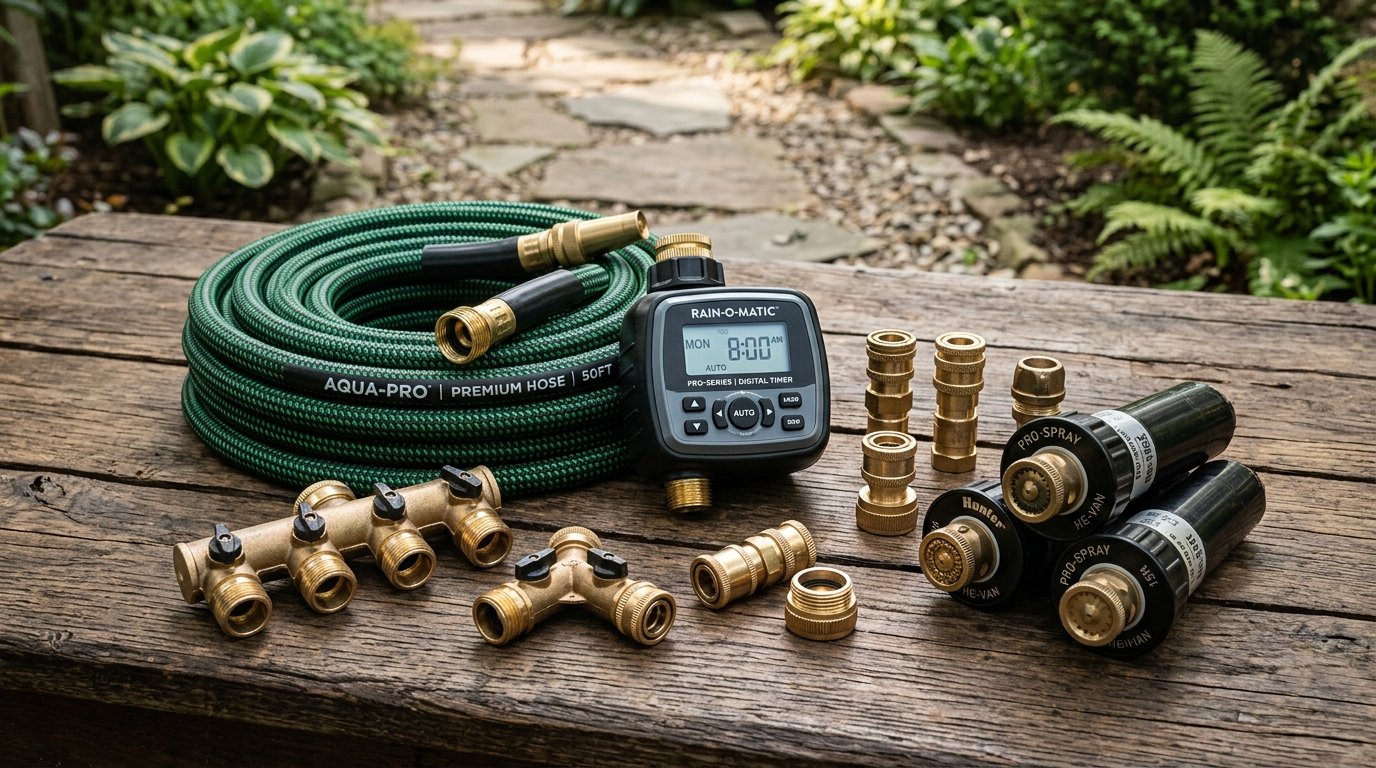
Pipe Fittings
Showing all 18 results
-

1 inch to 25mm male thread
-

1/2″ Drip Irrigation Fittings Kit
-

1/8″ 1/4″ Drip Irrigation Watering Connector
-

2-way watering hose fitting with shut-off tap for watering
-

3/4 Inch Garden Hose Repair Fitting
-

Brass Shut-Off Valve for 3/4 in Garden Hose
-

Brass two-way garden connector for hose
-

Faucet connector, garden accessories
-

Faucet connector, garden accessories
-

Garden Hose Connector 25mm 32mm to 1/2 Inch 16mm
-

Garden Hose Connector with Tap
-

Garden Hose Fitting with Shut-Off Valve for Landscaping
-

Garden Hose Repair Connector 1″ 1.5″ 2″
-

Garden Hose Repair Connector with Hose Clamps
-

Garden Hose Repair Kit
-

Garden Hose Repair Kit
-

Garden Irrigation Watering Connection Fittings
-

High Pressure Flexible Hose with Brass Fitting M22-14/15mm
The fittings for hoses are the central component of any high-performing watering system. Whether connecting a hose to a tap, joining several sections together, or adapting different diameters, choosing the right fitting determines the tightness and durability of your setup. An unsuitable fitting causes leaks, pressure loss and water waste that can reach 30% of the initial flow rate.
This category brings together universal adapters, threaded fittings, quick connectors and specialised adapters for IBC tanks or drip irrigation systems. Each type meets a specific need in terms of compatibility, working pressure and ease of installation. Mastering these differences lets you build a reliable, modular watering network.
Understanding the different types of hose fittings
Quick connectors and click-fit systems
Quick connectors let you connect and disconnect a hose without tools in seconds. This system works by snapping a male end into a female end with automatic locking. They generally withstand pressures of 4 to 12 bar and suit hoses with diameters of 13 mm, 15 mm and 19 mm.
The main advantage lies in modularity: you can easily swap your spray gun, wand or Y-connector without dismantling the whole setup. Most include an anti-drip system that stops flow when disconnecting. Do watch compatibility between brands, however, as some proprietary systems aren’t interchangeable.
Classic threaded fittings
Threaded fittings use a standard thread pitch to ensure tightness by compressing an O-ring or washer. The most common pitches are 20/27 (3/4 inch) and 15/21 (1/2 inch), measurements expressed in millimetres of inner and outer diameter. They offer superior mechanical hold and withstand pressures up to 16 bar.
This type of fitting suits fixed or semi-permanent installations where disassembly is infrequent. Hand-tightening is usually enough; over-tightening with a wrench risks crushing the seal and causing cracks. Always check the seal is present before assembly to avoid leaks.
Universal adapters and reducers
Adapters let you connect elements with different diameters or threads. A universal tap adapter fits outlets from 14 mm to 24 mm thanks to interchangeable seals or an expandable system. Reducers ensure a smooth transition between a 19 mm hose and a 13 mm fitting without loss of tightness.
Choosing the right diameter and compatibility
Matching hose to fitting
The hose’s inner diameter must match the fitting’s connector diameter exactly to guarantee tightness. Standard diameters are 13 mm (1/2 inch), 15 mm (5/8 inch) and 19 mm (3/4 inch). A 13 mm hose delivers a flow of 15 to 20 litres per minute, enough for manual watering over 10 to 15 metres.
For lengths over 20 metres or automatic irrigation systems, choose a 19 mm diameter, which maintains a flow of 25 to 30 litres per minute despite pressure losses. Always measure the hose’s inner diameter, not the outer diameter, which varies with wall thickness.
Working pressure and resistance
Average household mains pressure sits between 3 and 5 bar, with peaks reaching up to 8 bar. Your fittings should withstand at least 10 bar to offer an adequate safety margin. Brass or reinforced composite fittings typically tolerate 12 to 16 bar, while standard ABS plastic models are limited to 6 to 8 bar.
Compatibility between systems
If you already own a quick-connector system, check compatibility before buying new parts. Click-fit dimensions vary slightly between manufacturers. When in doubt, choose universal threaded fittings with a 20/27 pitch, which fit most taps and accessories on the market.
Materials and durability: brass, plastic or composite
Brass fittings
Brass offers the best mechanical strength and a lifespan of over 10 years under intensive use. This material is unaffected by UV, frost or impact. It keeps its tightness even after hundreds of screw/unscrew cycles thanks to its structural rigidity.
Its heavier weight and 30-50% higher cost compared to plastic are justified for critical connection points: main tap, pump outlet, buried fittings. Choose nickel-plated brass to avoid corrosion from hard water.
ABS plastic or polypropylene fittings
Technical plastic fittings combine light weight and chemical resistance. They don’t rust and withstand contact with liquid fertilisers or plant care products. Their lifespan reaches 5 to 7 years under standard use, provided they’re protected from direct sunlight, which weakens the material.
Favour this type of fitting for mobile connections: spray guns, Y-connectors, temporary branches. Avoid using them at points subject to vibration or repeated mechanical stress, where they risk cracking.
Reinforced composite fittings
Modern composites combine a plastic matrix with glass fibres or metal inserts. They offer a compromise between plastic’s light weight and brass’s robustness, with a pressure rating of 10 to 12 bar. Their resistance to UV and frost makes them suitable for permanent outdoor storage.
Quick connectors vs threaded fittings: which system to choose
Selection criteria based on use
Choose quick connectors if you frequently switch accessories or put your equipment away after each use. The effortless 2-second connection suits people with limited grip strength. These fittings are also ideal for modular systems with multiple branches.
Prefer threaded fittings for fixed installations, buried connections or points subject to repeated pulling. Their mechanical lock prevents accidental disconnection, even under high pressure. They remain the standard for tap adapters and pump outlets.
Compatibility and scalability
Threaded fittings with the standard 20/27 pitch guarantee universal compatibility across decades. Quick connectors evolve with manufacturers’ ranges, sometimes making it hard to replace a part after 5 or 6 years. For a long-lasting installation, mix both systems: threaded fittings at fixed points, quick connectors on mobile elements.
Specific adapters: taps, IBC tanks and irrigation systems
Universal tap adapters
These adapters fit tap outlets from 14 mm to 24 mm thanks to expandable sleeves or sets of interchangeable seals. They turn a threadless tap into a quick connection point for a garden hose. Check for a quality O-ring to avoid permanent drips that waste up to 120 litres a week.
Fittings for IBC tanks
IBC tanks use a specific S60x6 thread, incompatible with standard fittings. IBC adapters convert this thread into a 3/4-inch outlet or a quick-connect end. Choose a brass model for permanent installations, as plastic degrades under the weight and UV exposure after 2 to 3 seasons.
Fittings for drip irrigation
Automatic irrigation systems require small-diameter fittings (4 mm, 6 mm, 13 mm) compatible with PE tubing. Compression fittings ensure tightness without glue, while barbed fittings require clamping with a collar. For a 20 to 30 metre installation, plan for T-fittings, line end caps and pressure reducers if your network exceeds 3 bar.
| Fitting type | Recommended material | Max pressure | Main use |
|---|---|---|---|
| Quick connector | Reinforced composite | 10-12 bar | Frequent mobile connections |
| Threaded fitting 20/27 | Nickel-plated brass | 16 bar | Fixed installation, tap, pump |
| Universal adapter | ABS plastic | 8 bar | Threadless taps |
| IBC adapter S60x6 | Brass | 12 bar | Water harvesting tank |
| Drip fitting | Polypropylene | 4 bar | Automatic irrigation |
Selection criteria for high-performance fittings
- Hose inner diameter: measure precisely to avoid incompatibilities (13 mm, 15 mm or 19 mm)
- Working pressure: check the fitting withstands at least 10 bar for an adequate safety margin
- Material suited to use: brass for fixed points, technical plastic for mobile elements
- Connection type: quick connectors for modularity, threaded for robustness
- Presence of O-rings: essential to guarantee tightness, check their condition before assembly
- System compatibility: standardise on one quick-connector type or favour the universal 20/27 pitch
- UV and frost resistance: essential for outdoor storage or permanent installations
- Ease of disassembly: important if you put equipment away at the end of the season
How do I choose between a quick connector and a threaded fitting for my setup?
A quick connector suits frequent use requiring regular accessory changes, like switching from a spray gun to a watering wand. It connects in 2 seconds without tools and often includes an anti-drip system. A threaded fitting is best for fixed or semi-permanent installations: tap adapter, pump outlet, buried connections. Its mechanical hold prevents accidental disconnection under pressure. For a complete setup, combine both: threaded fittings at critical points, quick connectors on mobile elements.
What’s the difference between a brass fitting and a composite plastic fitting?
Brass offers a lifespan of over 10 years, withstands 16 bar of pressure and resists frost, UV and repeated impacts. It suits critical connection points despite a 30-50% higher cost. Reinforced composite plastic combines light weight and chemical resistance, tolerates 10 to 12 bar and doesn’t rust. It lasts 5 to 7 years under standard use and suits mobile connections. For fittings exposed to sunlight or subject to vibration, choose nickel-plated brass, which keeps its tightness after hundreds of cycles.
What working pressure should I size my watering fittings for?
Household mains pressure averages between 3 and 5 bar, with possible peaks of 8 bar during sudden variations. Your fittings should withstand at least 10 bar to offer an adequate safety margin and avoid ruptures. Brass or reinforced composite fittings typically tolerate 12 to 16 bar, while standard ABS plastic models are limited to 6 to 8 bar. For an installation with a pump or booster, check the discharge pressure and add a 30% margin.
How do I fit a standard hose to an IBC water harvesting tank?
IBC tanks use a specific S60x6 thread, incompatible with standard 20/27-pitch watering fittings. You need to install an IBC adapter that converts the S60x6 thread into a 3/4-inch outlet or a quick-connect end compatible with your hose. Choose a brass model for permanent installations, as plastic degrades within 2 to 3 seasons under the weight of the water and UV exposure. Check for a thick O-ring to guarantee tightness despite the significant weight of a full tank.