Sprinklers & Nozzles: Oscillating, Rotary, Drip
Showing 109–162 of 171 results
-

Garden hose nozzle sprayer
-

Garden Irrigation Micro Sprinklers
-

Garden Irrigation Swivel Sprinkler with Extension
-

Garden Micro Drip Irrigation
-

Garden misting nozzle for agricultural greenhouse
-

Garden Sprayer
-

Garden sprinkler, efficient water-distribution irrigation tool
-

Garden Watering Sprinkler
-

Garden watering, mist nozzle
-

Heavy-Duty 360 Rotating Micro Sprinkler
-

Heavy-Duty 90/180/360 Pop-Up Sprinklers
-

Heavy-Duty Adjustable Twisted Hose Jet Nozzle 31GJ
-

High Pressure Brass Water Gun Spray Nozzle
-

High Pressure Brass Water Hose Nozzle
-

High-Performance Detachable Garden Hose Nozzle with 400/1000 Holes
-

High-Power Pressure Garden and Car Wash Cleaner with Hose Nozzle Water Spray Gun
-

High-pressure cleaning hose 7.5/10/13/15m
-

High-Pressure Garden Hose Nozzle
-

High-Pressure Garden Hose Nozzle
-

High-pressure garden hose nozzle designed for foam cleaning cars and RVs
-

High-Pressure Garden Spray Gun
-

High-Pressure Garden Water Gun
-

High-pressure garden watering gun
-

High-Pressure Nozzle for Garden Hose
-

High-pressure spray nozzle for garden hose
-

High-pressure washer hose gun lance nozzle water jet
-

High-Pressure Water Hose Threaded Fitting
-

High-Pressure Water Spray Gun
-

Innovative High-Pressure Garden Sprayer with 7 Multi-Purpose Nozzles for Powerful Cleaning and Irrigation
-

Kit of 10 anti-drip hanging misting nozzles for hoses
-

Lawn irrigation micro sprinkler
-

Metal Spray Nozzle for Water Hose
-

Micro atomizing spray nozzle for garden
-

Mist watering nozzle for plants
-

Misting Cooling System with Brass Nozzle
-

Misting nozzle for garden irrigation
-

Misting Tool, Sprinkler
-

Multifunctional aluminum alloy ABS TPR garden hose wand
-

Multifunctional Garden Hose Nozzle
-

Multifunctional Water Hose Nozzle for Cleaning
-

Oscillating Arm Sprinkler Head for Gardening
-

Oscillating Lawn Sprinkler
-

Oscillating Lawn Sprinkler
-

Oscillating Lawn Sprinkler
-

Oscillating Lawn Sprinkler with 19 Precision Nozzles
-

Outdoor Misting Cooling System 15M-30M
-

Portable High Pressure Water Gun
-

Portable water spray nozzle
-

Powerful Adjustable High-Pressure Garden Hose Nozzle
-

Premium Garden Sprinkler
-

Quick-Connect Brass Metal Garden Sprayer
-

Remote Garden Lawn Sprinkler
-

Rotating jet sprinklers
-

Rust-Proof Telescopic Pop-Up Sprinkler
Sprinklers and nozzles: choosing by surface area and water pressure
A poorly chosen sprinkler ends up watering the neighbor’s patio or leaves a patch of lawn turning yellow three meters from the jet. The right choice depends on three measurable factors: the pressure available at the tap (typically 1.5 to 4 bar on a home network), the flow rate of the pump or tap (600 to 1200 L/h for standard residential use), and the actual area to cover. An oscillating sprinkler covers 200 to 250 m² at 3 bar, while a turbine-driven rotary model reaches 350 m² at the same pressure thanks to a more concentrated jet.
Oscillating, rotary or fixed nozzle: three distinct uses
The oscillating sprinkler sprays water through a perforated tube that sweeps a rectangular area, ideal for a regular 100 to 200 m² lawn. Its known weak point: reach drops off toward the edges of the sweep, creating dry patches at the borders if the area exceeds the manufacturer’s stated radius.
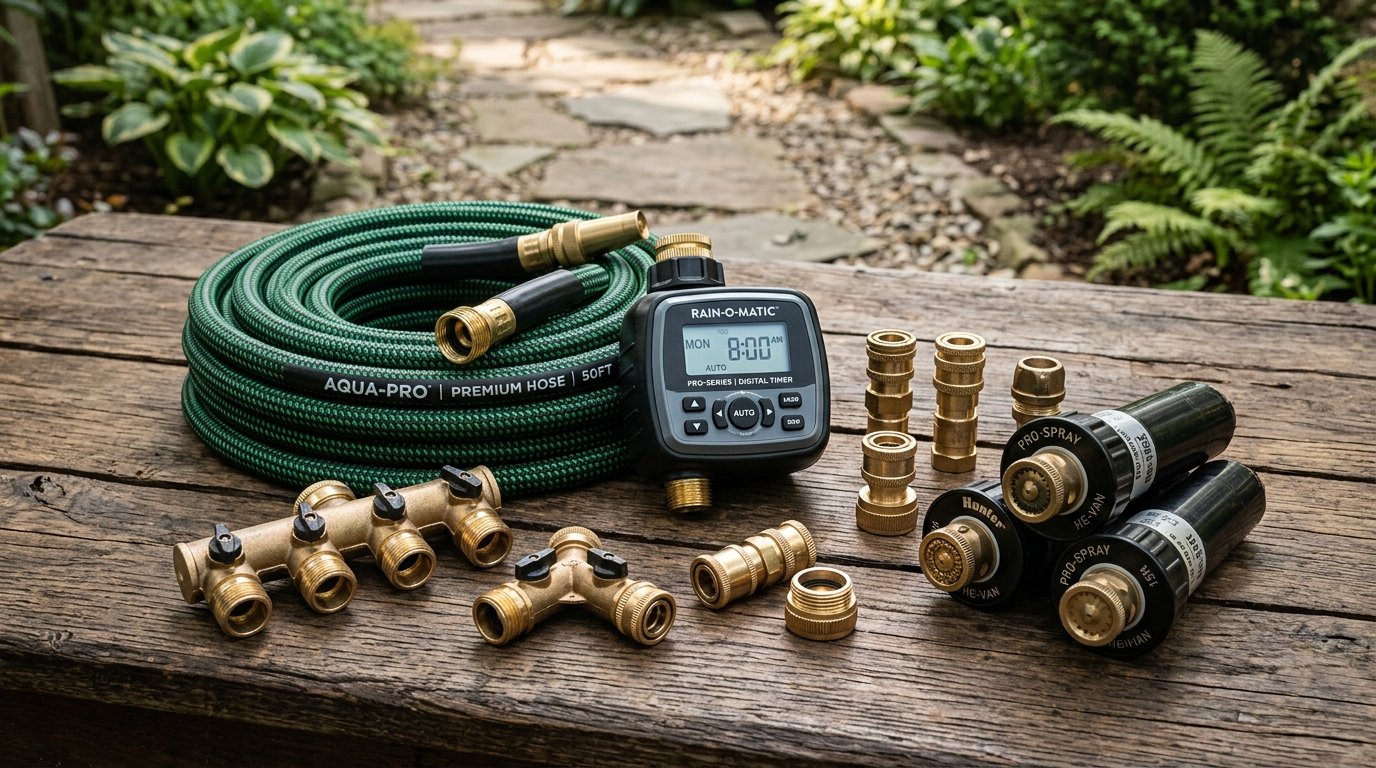
The turbine-driven rotary sprinkler (Hunter PGP, Rain Bird 5000) runs on internal hydraulic drive and covers adjustable circles or arcs from 40° to 360°. It handles wind better than an oscillating model and suits areas of 150 m² and up, though its price (€25 to €60 per unit for an in-ground model) exceeds that of an entry-level surface sprinkler at €10.
Adjustable nozzles for targeted watering
Nozzles screw onto a stake or perforated hose and cover 1 to 5 meters depending on the model: a 90-180° fan nozzle for flower beds, a flat-jet nozzle for a border, an anti-drip nozzle (check-valve) that prevents residual dripping after shut-off on sloped ground. A Netafim or Gardena Micro-Drip nozzle delivers 2 to 8 L/h in drip irrigation, versus several hundred liters/hour for a standard sprinkler: two uses that don’t substitute for one another.
Materials: brass, ABS and stainless steel
Brass resists UV rays and limescale but costs 3 to 4 times more than a fiberglass-reinforced ABS body. In hard water (above 25°f), limescale clogs nozzles within 12 to 18 months if no descaling is done; a stainless steel or brass body better withstands cleaning with a fine brush without cracking. ABS suits seasonal watering systems stored over winter, while brass suits a permanent in-ground installation.
Common installation mistakes
- Mixing nozzles with different flow rates on the same line: pressure drops and nozzles at the end of the line receive 30 to 40% less flow.
- Forgetting the upstream filter: low-opening turbines (0.5 mm) clog easily with sand or limescale particles.
- Adjusting a rotary sprinkler’s angle after the first rain rather than after the first full watering cycle, letting it water the driveway for weeks without anyone noticing.
Matching flow rate and pressure to your system
Before buying, measure the actual flow rate at the tap with a timed bucket test (for example, 10 liters in 30 seconds = 1200 L/h) rather than relying on the meter’s theoretical pressure. An electronic timer paired with 24V solenoid valves lets you separate zones by sprinkler type, preventing a 4 L/h drip nozzle and an 800 L/h rotary sprinkler from sharing the same circuit and the same cycle duration.
Range and angle: check the spec sheet before comparing prices
Two sprinklers at the same price sometimes list a range measured at maximum pressure (4 bar) that never holds up on a home network capped at 2.5 bar. Check the range given for 2 to 2.5 bar, the actual range for most single-family home setups, rather than the most flattering figure at the top of the product sheet.
Maintenance and lifespan
A well-maintained ABS sprinkler lasts 3 to 5 years of summer use; an in-ground brass or stainless steel model reaches 8 to 10 years if the nozzles are removed and rinsed with white vinegar once or twice a season to prevent scale buildup. Frost-free storage is essential once nighttime temperatures drop below 0°C: residual water in a turbine body cracks the plastic and jams the rotary mechanism the following spring.
Oscillating sprinkler or adjustable nozzle for a small garden?
For under 50 m², an adjustable fan nozzle on a stake is enough and costs less than an oversized oscillating sprinkler. Oscillating models become worthwhile beyond 100 m² of continuous lawn.
What’s the minimum pressure for a turbine rotary sprinkler?
Most turbine models start rotating from 1.5 bar, but the stated angle and range assume 2.5 to 3 bar. Below 1.5 bar, choose an oscillating sprinkler instead, as it’s less sensitive to inlet pressure.
How do you prevent limescale in nozzles?
Remove the nozzle, soak it for 30 minutes in pure white vinegar, then rinse with clean water before reassembling. In water above 25°f, repeat every 6 to 8 weeks during the watering season.
How do I choose between an oscillating, rotary, and drip system for my yard?
Match the sprinkler to the shape of the area. Oscillating models cover rectangular lawns up to about 4,000 sq ft with a fan of water. Rotary heads spin in circles, ideal for round or irregular plots. Drip lines deliver water at the root zone, which is the best sprinkler for vegetable garden beds, raised borders, and container rows.
What water pressure do these sprinklers need to work properly?
Most oscillating and rotary units perform between 30 and 60 PSI. Below 25 PSI the spray collapses and coverage shrinks noticeably. Drip kits are the opposite: they need a pressure regulator, typically 15 to 25 PSI, to avoid blowing emitters off the tubing. Check your outdoor tap with a low pressure garden hose sprinkler gauge before buying.
Are brass nozzles worth the extra cost over plastic ones?
Brass and zinc nozzles resist UV cracking and hard-water scaling far better than ABS plastic, and the threads survive repeated fitting changes. Plastic is fine for seasonal use on a small patio. If you irrigate daily through summer or use well water with sediment, a brass adjustable hose nozzle will typically outlast three or four plastic ones.
How do I stop nozzles and emitters from clogging?
Sediment and lime are the usual culprits. Fit an inline 120-mesh filter at the tap, flush the line ends at the start of each season, and soak affected heads in white vinegar overnight. For drip setups, pressure-compensating emitters resist blockage better than simple drippers. Regular clogged drip irrigation emitter cleaning every few months keeps flow rates even across the run.