Watering Accessories: Hoses, Timers and Drip Irrigation
Showing 163–196 of 196 results
-

T1 G1/2 garden hose reel cart
-

Teardrop-shaped hanging planter
-

Telescopic Garden Spray Wand
-

Terracotta watering globes – insert for self-watering pot – devices
-

Terracotta watering spikes
-

Terracotta watering spikes
-

Tomato Tower with Self-Watering Planter Box and Trellis – for Climbing Plants
-

Tulip Watering Globes for Plants – System
-

TurboWasher – Powerful High-Pressure Washer
-

Tuya – smart thermostat and wireless receiver
-

Type C DN16 Ground Stakes
-

Universal Free-Bend Spray Kit
-

Universal Free-Bend Spray Kit
-

Upgraded Solar Irrigation System
-

USB dual-probe water leak detector
-

Wall mount for garden hose
-

Wall mount for garden hose
-

Wall mount for garden hose
-

Wall-Mounted Garden Hose Holder
-

Wall-Mounted Garden Hose Holder
-

Wall-Mounted Holder for Irrigation Tools
-

Wall-mounted parrot statue for outdoor garden
-

Water Level Switch
-

Water mist cooling system
-

Water Pressure Reducer 1/2″ 3/4″ 1″ 2″ DN15 DN32 DN40
-

Water spray bottle for garden plants
-

Water Tank Protective Cover
-

Water Tank Protective Cover with Drawstring
-

Watering & Ground Cleaning Water Guns
-

Watering balls for garden tulip plants
-

Watering nozzle with universal spray head for plants and flowers
-

Watering Spray Lance
-

Wine Glass Self-Watering System: Slow-Release Root Feeding. PLA Resin. For Plants
-

Y-Type Garden Watering Filter
Watering accessories: choosing the right equipment based on pressure and flow rate
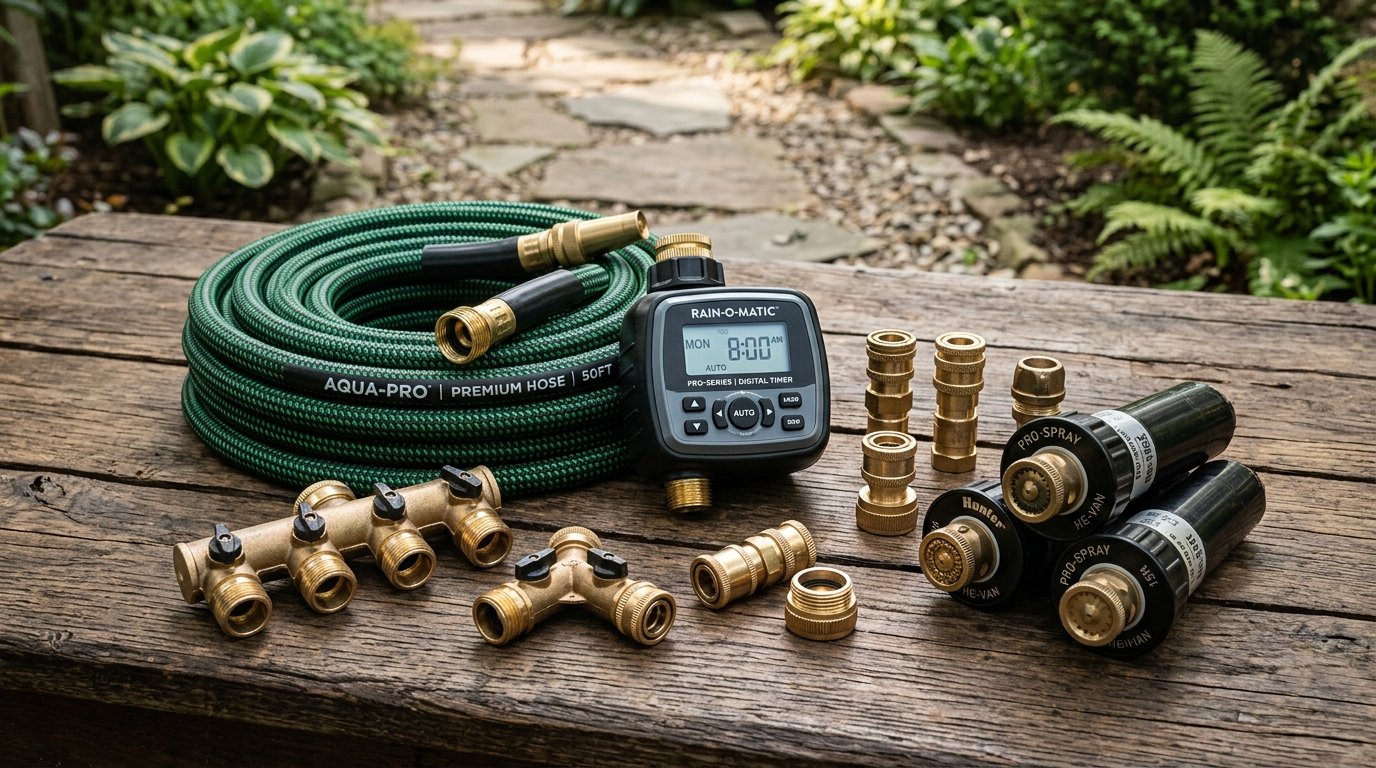
A garden hose is never a neutral choice: its diameter, pressure resistance and the quality of its fittings determine the lifespan of the entire setup. A 200 m² garden watered with a 15 mm hose at a pressure of 3 bars will empty a 1000-litre tank in about 45 minutes, compared to 25 minutes with a 19 mm hose at the same tap flow rate. This difference explains why diameter often matters more than brand.
Quick fittings remain the most common failure point: a brass fitting withstands a pressure of 12 bars without flinching, while an ABS plastic model cracks at just 6-7 bars after two or three winters outdoors. For a setup that stays connected all season, brass pays for its extra cost by the second year.
Watering timers: mechanical or electronic?
A mechanical dial timer, the kind still found at Gardena since the 1990s, handles a single watering cycle per day and runs without a battery. That’s enough for a vegetable patch watered early in the morning. An electronic multi-program model, on the other hand, allows up to four daily cycles and adapts to a garden with shaded and full-sun areas that don’t have the same water needs. The CR2032 lithium battery that powers it typically lasts 12 to 18 months depending on how often cycles are programmed.
Watering guns and lances: the right spray for every use
A gun with 7 or 8 adjustable spray patterns covers most household needs, from a fine mist for seedlings to a jet spray for cleaning a terrace. For a vegetable garden, a fine mist limits soil compaction around young plants, unlike a direct jet that digs craters around shallow roots.
- 15 mm hose: garden under 100 m², standard mains pressure
- 19 mm hose: area over 150 m² or watering several zones at once
- Brass fittings: fixed setup left in place all season
- Reinforced ABS fittings: occasional use, hose stored after each use
Wall-mounted and mobile reels: protecting the hose from frost and UV
A hose left exposed to direct sunlight loses its flexibility within two to three seasons: PVC hardens under UV exposure and eventually splits at the first slightly stiff fold. A wall-mounted reel or mobile cart prevents this premature ageing and also reduces kinks, which over time create weak points in the sheath. In winter, the hose must be fully drained before storage: residual water that freezes inside a 15 mm hose expands the material and causes micro-cracks invisible to the naked eye, which only show up in spring under pressure.
Drip irrigation and micro-sprinklers: water savings you can measure
A well-adjusted drip irrigation system uses about 2 to 4 litres per hour per dripper, compared to 10 to 15 litres per minute for a standard hose left running. On a 30 m² flower bed watered three times a week, the consumption gap over a full season easily reaches several thousand litres. Micro-sprinklers, meanwhile, are better suited to dense flower beds where individual drippers would be too slow to cover the whole root area.
Filters and pressure reducers: protecting fine nozzles
A dripper or micro-sprinkler nozzle clogs quickly if the water contains limescale or fine particles, which is common with water drawn from a rainwater tank. A 130-mesh filter installed at the head of the system catches most impurities before they reach the 0.5 to 1 mm nozzles, which are particularly prone to blockages.
What hose diameter should I choose for a medium-sized garden?
For an area between 100 and 150 m², a 15 to 19 mm hose with a standard tap flow rate (around 15 L/min) covers your needs without excessive watering time.
How can I stop fittings leaking after a few months?
Choose brass fittings over plastic and check the O-ring once a season: it’s the O-ring, not the fitting itself, that fails first in 80% of cases.
Should watering equipment be drained before winter?
Yes, always: water that freezes inside a hose or timer that hasn’t been drained causes internal cracks that only appear when it’s put back into use.
Is drip irrigation suitable for potted plants?
Yes, provided you install an adjustable low-flow dripper (0.5 to 2 L/h) per pot, to prevent water from pooling at the bottom of the container.
What’s the difference between a multi-spray gun and a watering lance?
The multi-spray gun adapts to varied uses throughout the day, while the lance offers a longer reach, useful for watering a raised bed without bending down.